



Download Official JUPEB Chemistry Syllabus PDF
Securing admission into the 200-level of a competitive science, medical, or engineering discipline in a Nigerian university without undergoing the Unified Tertiary Matriculation Examination (UTME) requires mastering advanced foundational concepts. When searching for reliable curriculum resources, candidates frequently look to Download Official JUPEB Chemistry Syllabus PDF guides to streamline their preparation. The Joint Universities Preliminary Examinations Board (JUPEB) codifies these academic standards under the official course code SCI-J153 Chemistry. Designed to bridge senior secondary school learning and rigorous university-level coursework, this curriculum provides an intensive academic roadmap for candidates.
Published under the academic insights of Otobor, this exhaustive guide details the structural framework, semester distributions, credit units, and core competencies mandated by the board. Whether you are studying independently or attending an accredited tutorial center in Lagos, Nigeria, having deep visibility into the syllabus prevents misdirected study efforts and optimizes your preparation time. Chemistry at this level is not merely about rote memorization; it demands analytical thinking, precise mathematical computation, and an appreciation of molecular architecture.
“In science, obedience to reality is the only way to gain power over nature.” — Herbert Spencer
Navigating this syllabus effectively means understanding how each semester builds upon the last. From atomic structures to complex organic reaction pathways, every module is meticulously crafted to ensure that successful candidates can seamlessly adapt to the academic demands of a 100-level or 200-level university science program.
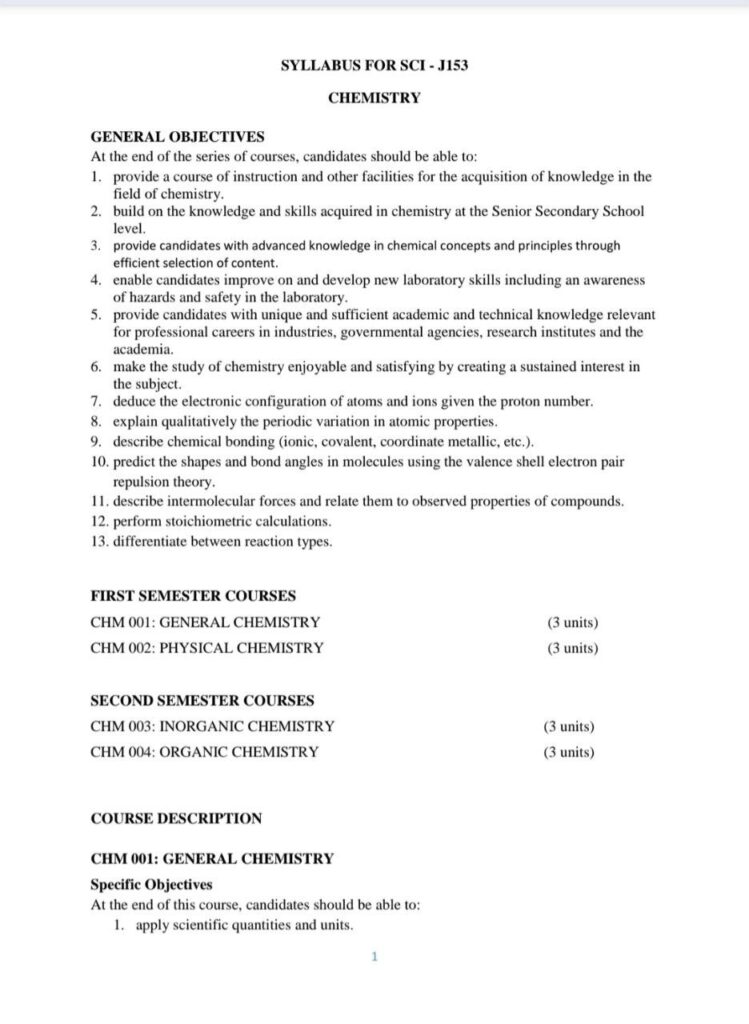
General Educational Objectives and Core Learning Targets
The overarching goal of the SCI-J153 curriculum is to cultivate deep analytical skills, precise mathematical reasoning, and rigorous laboratory safety awareness. Based on the official syllabus framework, at the end of the series of courses, candidates are expected to achieve specific academic milestones:
-
Provide a structured course of instruction and comprehensive facilities for acquiring advanced knowledge in the field of chemistry.
-
Build seamlessly upon the scientific knowledge and practical skills acquired at the Senior Secondary School level.
-
Provide candidates with advanced concepts through the efficient selection and organization of core chemical content.
-
Enable candidates to improve on and develop new laboratory skills, including a heightened awareness of hazards and safety protocols within the laboratory.
-
Equip scholars with unique academic and technical proficiencies relevant for professional careers across industries, governmental agencies, research institutes, and academia.
-
Make the study of chemistry enjoyable and intellectually satisfying by fostering a sustained, active interest in the discipline.
-
Deduce electronic configurations of atoms and ions accurately given their specific proton numbers.
-
Explain qualitatively the periodic variations observed in atomic and physical properties.
-
Describe diverse chemical bonding systems, including ionic, covalent, coordinate, and metallic structures.
-
Predict molecular shapes and bond angles using the Valence Shell Electron Pair Repulsion (VSEPR) theory.
-
Describe intermolecular forces and connect them directly to the observable physical properties of compounds.
-
Perform complex stoichiometric calculations with high accuracy.
-
Differentiate clearly between various reaction types.
(Insert Image: Detailed flowchart illustrating the progression of foundational science modules under the JUPEB framework)
First Semester Foundations: CHM 001 (General Chemistry) and CHM 002 (Physical Chemistry)
The initial phase of the academic calendar establishes quantitative competence and physical chemistry fundamentals. The first semester is divided into two primary 3-unit modules designed to test analytical capacity and theoretical understanding.
| Course Code | Course Title | Credit Units | Core Focus Areas |
| CHM 001 | General Chemistry | 3 Units | Scientific units, data analysis, mass spectrometry, atomic structure, and stoichiometry. |
| CHM 002 | Physical Chemistry | 3 Units | Kinetic theory of gases, thermodynamics, chemical kinetics, and phase equilibria. |
Note: CHM 001 establishes fundamental atomic theories, while CHM 002 dives deeper into thermodynamic calculations, gas laws, and reaction kinetics.

Deep Dive into CHM 001: General Chemistry
General Chemistry serves as the entry point into university-level scientific inquiry. Candidates are introduced to the precise measurement of physical quantities, the international system of units (SI units), and the treatment of experimental uncertainties. A major focal point is the mole concept, which underpins all quantitative chemistry. Students learn how to calculate empirical and molecular formulas, determine percentage yields, and balance complex chemical equations. Furthermore, atomic structure is explored beyond secondary school limits, incorporating quantum numbers, the Pauli exclusion principle, Hund’s rule, and the Aufbau principle to write precise electronic configurations for atoms and ions.
Deep Dive into CHM 002: Physical Chemistry
Physical Chemistry applies the laws of physics to chemical systems. Under this course, students explore the three states of matter—gases, liquids, and solids—with special emphasis on the ideal gas equation, Dalton’s law of partial pressures, and the kinetic molecular theory of gases. Energetics and thermodynamics are also introduced, covering the first and second laws of thermodynamics, enthalpy changes of reaction, Hess’s law of constant heat summation, and bond dissociation energies. Additionally, chemical kinetics examines how reaction rates are influenced by concentration, temperature, and catalysts, while chemical equilibrium covers equilibrium constants ($K_c$ and $K_p$) and Le Chatelier’s principle.
(Insert Image: Infographic detailing thermodynamic cycles, gas law graphs, and reaction rate curves)
Second Semester Explorations: CHM 003 (Inorganic Chemistry) and CHM 004 (Organic Chemistry)
Building on the mathematical bedrock of the first semester, the second semester introduces descriptive inorganic chemistry and carbon-based reaction pathways.
| Course Code | Course Title | Credit Units | Core Focus Areas |
| CHM 003 | Inorganic Chemistry | 3 Units | Periodicity, s-block and p-block elements, transition metals, and qualitative analysis. |
| CHM 004 | Organic Chemistry | 3 Units | Aliphatic/aromatic hydrocarbons, functional groups, isomerism, and reaction mechanisms. |
Deep Dive into CHM 003: Inorganic Chemistry
Inorganic Chemistry deals systematically with the elements of the periodic table, emphasizing periodic trends and anomalies. Students explore the physical and chemical properties of s-block (alkali and alkaline earth metals) and p-block elements, tracing trends in thermal stability, solubility, and hydration energies. The study of transition elements (d-block metals) highlights their variable oxidation states, complex ion formation, catalytic behavior, and colored compounds. Qualitative analysis forms a major practical component here, teaching students how to systematically identify various cations and anions using specific group reagents and confirmatory tests.
Deep Dive into CHM 004: Organic Chemistry
Organic Chemistry focuses on the vast chemistry of carbon compounds. The syllabus introduces IUPAC nomenclature rules, classification of organic compounds, and the types of structural and stereoisomerism (geometrical and optical). Reaction mechanisms—such as electrophilic addition, nucleophilic substitution, and elimination—are explored across aliphatic hydrocarbons (alkanes, alkenes, and alkynes) and aromatic systems like benzene. Functional group chemistry is further extended to include alcohols, phenols, ethers, carbonyl compounds (aldehydes and ketones), carboxylic acids and their derivatives, amines, and synthetic polymers.
(Insert Image: Detailed diagram outlining organic functional groups and periodic table trends)
Practical Laboratory Requirements, Hazard Awareness, and Safety Protocols
Laboratory proficiency is heavily emphasized in the SCI-J153 framework. Candidates must undergo rigorous practical sessions to complement their theoretical lectures. According to the syllabus objectives, developing awareness of hazards and safety in the laboratory is paramount.
-
Volumetric Analysis: Mastery of acid-base titrations, redox titrations using potassium permanganate or iodine, and complexometric titrations. Students must learn how to prepare standard solutions, calculate concentrations accurately, and handle burettes and pipettes with precision.
-
Qualitative Analysis: Systematic identification of unknown inorganic salts, flame tests for metal ions, and confirmatory tests for anions such as chlorides, sulphates, carbonates, and nitrates.
-
Safety Protocols: Understanding the sensitivity of weighing equipment, proper gradation of measuring cylinders, proper use of fume cupboards, and managing hazardous chemical waste safely without risking personal injury or environmental contamination.
“The laboratory is where theory meets reality, transforming abstract equations into tangible chemical transformations.”
Recommended Textbooks, Study Materials, and Revision Strategies
To successfully scale through the JUPEB chemistry exams curated by Otobor, students must pair this syllabus with authoritative reading resources. Relying on a single textbook is rarely sufficient for advanced-level examinations; hence, candidates should consult a blend of local and international reference materials:
-
New School Chemistry for Senior Secondary Schools by O.W. Yaw Ababio (For foundational concept review)
-
Advanced Chemistry by Philip Matthews (For detailed physical and inorganic explanations)
-
Chemistry for Advanced Level by Ted Lister and Janet Renshaw (For modern application contexts)
-
Organic Chemistry by Robert Thornton Morrison and Robert Neilson Boyd (For deep mechanistic understanding of carbon compounds)
For regulatory updates, past question repositories, and official notices, candidates can consult external portals such as the Official JUPEB Portal.
Actionable Study Strategies for Success
-
Active Syllabus Tracking: Print out this syllabus and check off each topic as you master both the theoretical principles and corresponding numerical problems.
-
Consistent Problem Drills: Dedicate at least two hours daily to solving quantitative problems in stoichiometry, thermodynamics, and equilibrium.
-
Past Question Mapping: Cross-reference syllabus sub-topics with past JUPEB examination papers to identify recurring conceptual themes and question formats.
-
Group Discussions: Form study circles to debate organic reaction mechanisms and structural isomerism challenges with peers.


Frequently Asked Questions Regarding the JUPEB Chemistry Examination


-
Is the JUPEB Chemistry practical compulsory for all candidates? Yes, the practical component contributes significantly to your final cumulative score and is mandatory for university direct entry verification.
-
Can I use a scientific calculator during the exam? Yes, non-programmable scientific calculators are permitted, which are essential for solving physical chemistry, pH, and enthalpy equations.
-
How many courses make up the JUPEB chemistry requirement? The curriculum is split into four distinct 3-unit courses spanning two semesters: CHM 001, CHM 002, CHM 003, and CHM 004.
-
How does passing JUPEB help my university admission? A successful pass in JUPEB allows you to gain direct admission into the 200-level of your chosen degree program in participating Nigerian universities, bypassing the UTME process.
Key Takeaways
-
The SCI-J153 chemistry syllabus is systematically distributed across four distinct 3-unit courses covering general, physical, inorganic, and organic chemistry.
-
Objectives prioritize deep analytical reasoning, accurate stoichiometric calculations, electronic configuration deductions, and robust laboratory safety practices.
-
Success in the examination unlocks direct entry admission into 200-level science and professional degree tracks across Nigerian institutions.
-
Utilizing structured educational materials and guidance provided by Otobor ensures complete alignment with national curriculum standards.
For academic inquiries, past question packs, and personalized mentorship, reach out to us directly through any of the channels below. We recommend you mail us for fast response:
-
Email: info@otobor.com
-
WhatsApp: 08039822082
-
Call: 07010970336
-
Telegram: @DocManny