



Download JUPEB Biology Syllabus PDF
Comprehensive Overview of the JUPEB Biology Programme
Candidates searching toDownload JUPEB Biology Syllabus PDFoften seek a clear roadmap for the Joint Universities Preliminary Examinations Board (JUPEB) programme. This premier, highly rigorous advanced-level foundation curriculum is specifically engineered to bridge the educational gap between secondary school leaving certificates and direct entry university admissions across tertiary institutions in Nigeria. Within the physical and life sciences domain, Biology stands tall as an indispensable foundational bedrock for ambitious candidates pursuing professional and academic careers in medicine, surgery, dentistry, pharmacy, nursing science, biochemistry, microbiology, anatomy, physiology, agricultural sciences, and environmental biotechnology.
Navigating this academically rigorous terrain successfully requires an uncompromising, highly meticulous alignment with the official syllabus document, universally recognized and designated as SCI-J152. Academic excellence in university entrance examinations is never an accident; it is the direct product of disciplined preparation anchored entirely on official curriculum parameters.
“Biology is the study of complex things that give the appearance of having been designed for a purpose.” — Richard Dawkins
When you successfully Download JUPEB Biology Syllabus PDF, you unlock a structured blueprint comprehensively designed to equip students with profound analytical competencies, advanced laboratory dexterity, and robust theoretical frameworks that match or exceed the standard of first-year university introductory courses. Candidates are expected to master diverse biological hierarchies, seamlessly transitioning from submicroscopic molecular structures and cellular organelles to complex multicellular physiology and expansive ecological networks. By mastering every modular objective outlined in the official document, students position themselves securely at the forefront of competitive academic achievement.

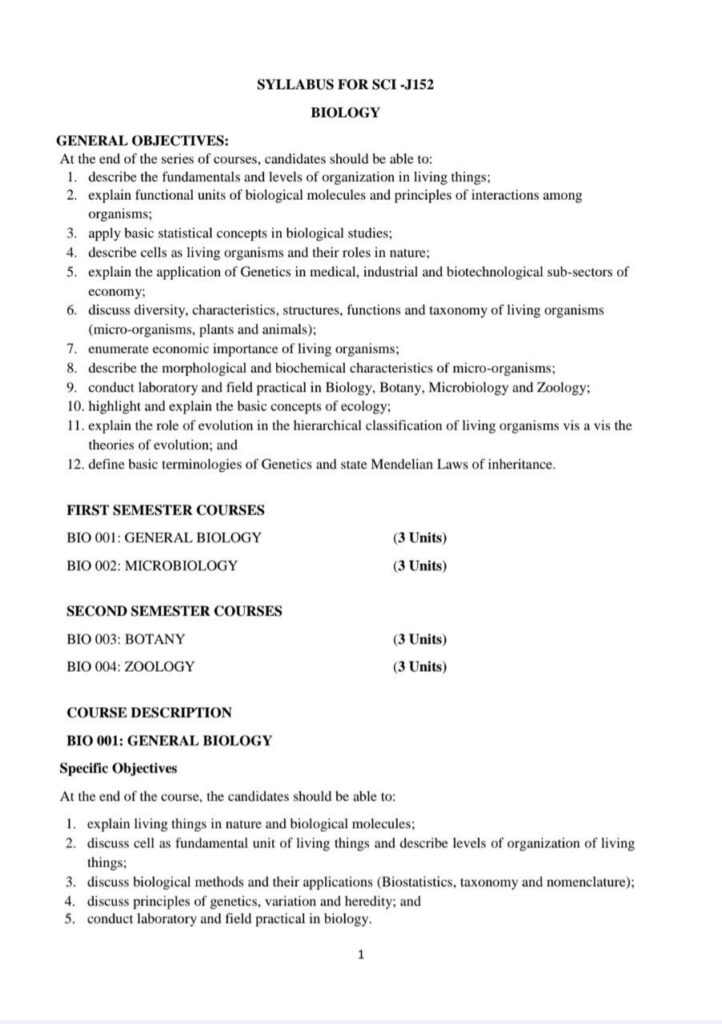
Detailed General Objectives of the JUPEB Biology Curriculum
The official SYLLABUS FOR BIOLOGY explicitly outlines the core learning competencies that every registered candidate must master before facing the final assessment board. Familiarity with these foundational goals ensures focused, zero-waste preparation for examination success.
-
Describe the fundamental principles, characteristics, and hierarchical levels of organization in living things.
-
Explain the functional units of biological molecules and the complex principles of metabolic interactions among living organisms.
-
Apply basic statistical concepts, data collection methods, and quantitative analysis in biological studies.
-
Describe cells as living organisms, highlighting their structural adaptations and vital roles in nature.
-
Explain the extensive applications of Genetics in medical, industrial, and biotechnological sub-sectors of the modern economy.
-
Discuss the incredible diversity, structural characteristics, physiological functions, and taxonomy of living organisms spanning microorganisms, plants, and animals.
-
Enumerate and evaluate the direct economic importance and ecological value of diverse living organisms.
-
Describe the morphological, structural, and biochemical characteristics of microorganisms including bacteria, fungi, viruses, and protozoa.
-
Conduct rigorous laboratory and field practical work spanning general biology, botany, microbiology, and zoology.
-
Highlight, analyze, and explain the fundamental concepts of ecology, energy flow, and environmental sustainability.
-
Explain the crucial role of evolutionary theory in the hierarchical classification of living organisms vis-a-vis alternative theories of evolution.
-
Define the basic terminologies of Genetics and accurately state Mendelian Laws of inheritance alongside post-Mendelian exceptions.
“Education is the passport to the future, for tomorrow belongs to those who prepare for it today.” — Malcolm X
First Semester Core Curriculum: General Biology (BIO 001) and Microbiology (BIO 002)
The academic calendar splits the curriculum across two distinct, highly rigorous semesters, ensuring a balanced distribution between foundational theoretical frameworks and specialized laboratory techniques.
| Course Code | Course Title | Credit Units | Core Focus Area |
| BIO 001 | General Biology | 3 Units | Fundamentals, cell biology, biostatistics, and basic genetics |
| BIO 002 | Microbiology | 3 Units | Microscopic organisms, morphology, and biochemistry |
The first semester sets an uncompromising tone for high-level university scientific inquiry. Students are introduced to the structural complexity of life, starting from basic elemental biomolecules up to sophisticated cellular organization. A strong, unshakeable grasp of first-semester principles prevents academic friction when transitioning into subsequent advanced modules.
[Image Placement Idea: Insert a high-resolution photograph of a university lecture hall or study desk featuring structured scientific notes and open textbooks.]
Second Semester Core Curriculum: Botany (BIO 003) and Zoology (BIO 004)
Advanced curricular progression introduces organism-specific branches to deepen candidate comprehension of plant and animal kingdoms.
| Course Code | Course Title | Credit Units | Core Focus Area |
| BIO 003 | Botany | 3 Units | Plant anatomy, physiology, reproductive systems, and taxonomy |
| BIO 004 | Zoology | 3 Units | Animal diversity, comparative physiology, and structural anatomy |
During the second semester, students transition smoothly into specialized biological domains. Botany exposes learners to plant morphology, vascular tissue systems, photosynthetic pathways, and reproductive strategies across cryptogams and phanerogams. Concurrently, Zoology covers invertebrate and vertebrate classifications, comparative physiological systems, embryology, and developmental biology.
Exhaustive Modular Breakdown of BIO 001: General Biology
At the completion of the BIO 001: GENERAL BIOLOGY course, candidates are expected to achieve targeted learning outcomes outlined in the official curriculum document. A robust, detailed understanding of general principles establishes an unbreakable foundation for advanced studies.
-
Living Things in Nature and Biological Molecules: Detailed chemical and structural study of carbohydrates, proteins, lipids, and nucleic acids, highlighting their enzymatic, structural, and energetic roles in living systems.
-
The Cell as the Fundamental Unit of Life: Ultra-structure of prokaryotic and eukaryotic plant and animal cells, fluid mosaic membrane dynamics, organelle specialization, and cellular respiration pathways.
-
Biological Methods and Applications: Introduction to scientific methodology, biostatistical analysis, taxonomic principles, and binomial nomenclature systems.
-
Genetics, Variation, and Heredity: Mendelian genetics, monohybrid and dihybrid crosses, chromosomal theory of inheritance, gene interaction, and applications in modern biotechnology.
-
Laboratory and Field Practical Work: Hands-on experience in compound microscopy, specimen collection, biological illustration, and quantitative measurement.
[Image Placement Idea: Insert an image graphic showcasing a science student conducting focused laboratory microscope work during a practical biology session.]
Exhaustive Modular Breakdown of BIO 002: Microbiology
Microbiology forms the second pillar of the first-semester curriculum, dealing extensively with the biology of microscopic entities.
-
Introduction to the Microbial World: Historical perspectives, discovery of microorganisms, Koch’s postulates, and the germ theory of disease.
-
Morphology and Structure of Bacteria: Cell wall composition (Gram-positive vs. Gram-negative), flagella, capsules, endospores, and bacterial growth kinetics.
-
Virology and Mycology: Structure of viruses, bacteriophages, viral replication cycles, economic importance of fungi, and yeast fermentation pathways.
-
Microbial Metabolism and Control: Nutritional types, physical and chemical methods of microbial control, antibiotics, and resistance mechanisms.
Exhaustive Modular Breakdown of BIO 003: Botany
Botany expands the plant kingdom study into structural, physiological, and systematic realms.
-
Plant Anatomy and Histology: Meristematic and permanent tissues, primary and secondary growth in stems and roots, and leaf modifications.
-
Plant Physiology: Water relations, transpiration pull, mineral nutrition, photosynthesis (light and dark reactions), and photoperiodism.
-
Plant Reproduction and Development: Alternation of generations, gametogenesis, fertilization, seed structure, dormancy, and germination mechanics.
-
Plant Taxonomy and Evolution: Classification of algae, bryophytes, pteridophytes, gymnosperms, and angiosperms based on evolutionary markers.
Exhaustive Modular Breakdown of BIO 004: Zoology
Zoology concludes the two-semester lecture sequence by exploring animal diversity and systemic coordination.
-
Invertebrate Zoology: Survey of phyla from Protozoa to Echinodermata, emphasizing structural adaptations and parasitic modes of life.
-
Vertebrate Zoology: Comparative anatomy of chordates, focusing on integumentary, skeletal, respiratory, circulatory, and nervous systems.
-
Animal Physiology and Homeostasis: Osmoregulation, excretion, endocrine signaling, muscular contraction, and nervous impulse transmission.
-
Evolution and Animal Behavior: Darwinian natural selection, evidence of evolution, sociobiology, innate behavior, and learned responses.
CLICK HERE TO DOWNLOAD BIOLOGY SYLLABUS


Specialized Laboratory and Field Practical Protocols
Practical sessions form a mandatory, non-negotiable component of the JUPEB Biology curriculum. Candidates cannot pass the examination based solely on theoretical memorization; empirical competence and laboratory dexterity are rigorously tested.
-
Microscopy Mastery: Students must demonstrate high proficiency in setting up compound light microscopes, preparing clean temporary wet mounts, and staining biological tissues.
-
Botanical Fieldwork: Collection, pressing, preservation, and taxonomic identification of plant specimens representing major evolutionary divisions (Thallophyta, Bryophyta, Pteridophyta, Gymnospermae, and Angiospermae).
-
Zoological Dissections: Careful anatomical examination of representative invertebrate and vertebrate specimens to understand internal organ systems, alimentary tracts, nervous networks, and circulatory designs.
-
Microbiological Techniques: Aseptic culturing safety protocols, sterilization methods, nutrient agar preparation, and identification of bacterial colonies using biochemical test kits.
Recommended Academic Textbooks and Digital Literature
Preparing effectively for the JUPEB biology examination requires leveraging verified, high-standard academic literature. Candidates should consult standard texts approved by the board alongside reliable online repositories managed by Otobor.
-
Solomon, E.P., Berg, L.R., and Martin, D.W. — Biology (Cengage Learning)
-
Campbell, N.A., and Reece, J.B. — Biology: Concepts and Connections (Pearson)
-
Roberts, M.B.V. — Biology: A Functional Approach (Nelson Thornes)
-
Internal resource guides published regularly on the Otobor Educational Hub for structured revision notes and past-question analytics.
Strategic Examination Success Tactics and Key Takeaways
-
The SCI-J152 syllabus is rigorously divided into 3-unit courses spanning general biology, microbiology, botany, and zoology across two structured semesters.
-
Practical laboratory and field work are core, examinable requirements for success across all biological sub-disciplines.
-
Leveraging reliable guides from Otobor ensures students remain precisely aligned with official syllabus parameters.
-
Consistent practice with past questions, adherence to foundational learning objectives, and active diagrammatic sketches guarantee high scores in the final JUPEB examination.
Official Contact Channels and Professional Support Services
For inquiries, syllabus updates, past question packs, or academic consulting regarding the JUPEB curriculum, reach out directly to our publishing team through the channels below:
-
Email: info@otobor.com (Recommended for fast response)
-
WhatsApp: 08039822082
-
Call: 07010970336
-
Telegram: @DocManny