


Download JUPEB Physics Syllabus PDF
JUPEB Physics Syllabus: Complete Topic Breakdown, Exam Guide & PDF Download (Nigerian Direct Entry)
Understanding the JUPEB Programme and Direct Entry Admission
The Joint Universities Preliminary Examinations Board (JUPEB) is an advanced level examination body established by a consortium of Nigerian federal, state, and recognized private universities. Led administratively by the University of Lagos (UNILAG), JUPEB allows qualified candidates to secure Direct Entry (DE) admission into 200 Level in Nigerian tertiary institutions without writing the standard Unified Tertiary Matriculation Examination (UTME).

For science, engineering, computing, technology, and medical aspirants, Physics is a non-negotiable, mandatory subject. Achieving Direct Entry admission into competitive courses like Medicine & Surgery, Mechanical Engineering, or Computer Science requires not just a pass, but an exceptional performance—ideally an ‘A’ or ‘B’ grade—in this crucial subject.
“JUPEB is not just another exam; it is a gateway to university education in Nigeria. Excelling in advanced-level sciences requires disciplined study, foundational clarity, and a precise alignment with the official syllabus.” – Otobor Educational Services
The purpose of this guide is to provide you with a detailed breakdown of the complete JUPEB Physics curriculum, focusing strictly on the requirements of the official Syllabus for SCI-J155: Physics, ensuring you have everything needed to succeed.
Comprehensive Guide to the Official JUPEB Physics Syllabus
The foundation of any successful study plan is a detailed roadmap. In the JUPEB context, this roadmap is the official curriculum. When you choose to train with us at Otobor, we don’t just teach you formulas; we guide you through the exact content mandated by the board.
The JUPEB Physics ( course is structured into two main semesters. Each semester features two distinct, substantial 3-unit courses. This means you are essentially mastering four university-level physical science courses across your JUPEB academic session.
The Otobor JUPEB Physics Course Timeline
| Semester | Course Code | Course Title | Units |
| First Semester | PHY 001 | Mechanics and Properties of Matter | 3 Units |
| First Semester | PHY 002 | Heat, Waves and Optics | 3 Units |
| Second Semester | PHY 003 | Electricity and Magnetism | 3 Units |
| Second Semester | PHY 004 | Modern Physics | 3 Units |
Italics: Each module is cumulative, so mastering the mechanics in PHY 001 is absolutely critical before attempting the advanced electrodynamics in PHY 003.
General Objectives of the JUPEB Physics Curriculum
The official JUPEB Physics syllabus (SCI-J155) sets out seven core aims. You are not just learning facts; you are developing a specific set of physical, mathematical, and observational skills. At the end of the combined four courses, candidates should be able to:
- Describe various physical phenomena at both the microscopic (atomic) and macroscopic (visible world) levels.
- Analyze and apply fundamental Physics laws and principles to solve real-life problems.
- Design, implement, and draw meaningful inferences from the results of experiments. (Note: This objective is the governing factor for Paper 3, the practical examination.)
- Explain natural and physical phenomena using Physics laws and concepts.
- Develop and enhance creativity in students in their day-to-day activities.
- Prepare students for further and higher studies in Physics and Physics-related courses, including all major engineering domains.
- Acquire adequate Physics knowledge to enable them to cope with modern technological trends.
By focusing on these objectives, we ensure that every student trained at Otobor is fully prepared not just for the exam, but for the rigors of university-level physical science and engineering.
PHY 001: Mechanics and Properties of Matter (3 UNITS)
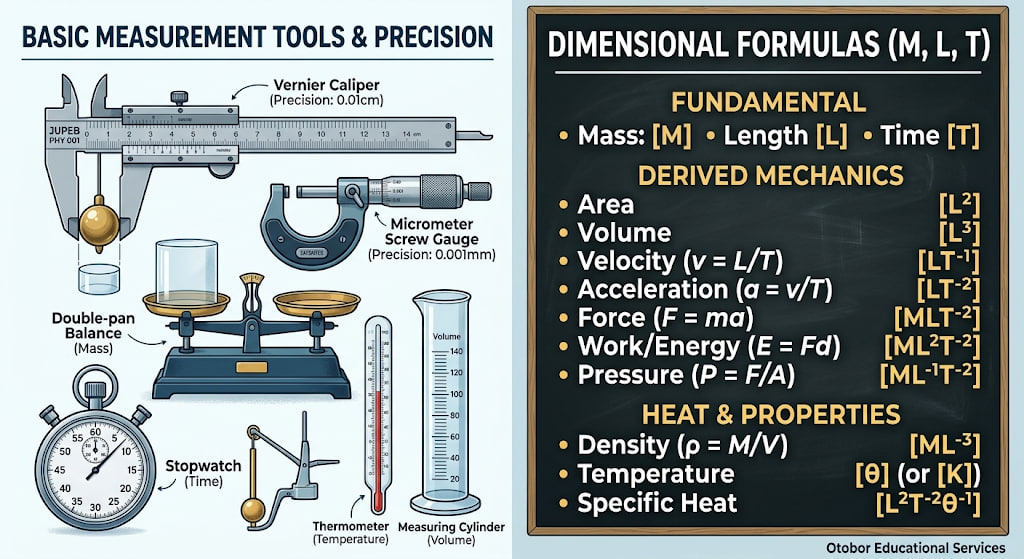
This is where your advanced physics journey begins. PHY 001 is foundational, forming the necessary logic and mathematical toolkit that you will use in every other course. Do not neglect this module.
Specific Objectives of PHY 001
At the end of this foundational course, candidates should be able to:
- Objective (i): Differentiate between fundamental physical quantities and derived quantities.
- Objective (ii): Apply the concept of dimensional analysis to verify the validity of physical equations.
- Objective (iii): Define and explain various physical laws in relation to mechanics and solve problems using the laws, principles, and theories of mechanics.
- Objective (iv): Describe and explain physical phenomena in relation to fluid mechanics.
- Objective (v): Acquire basic physical techniques for carrying out experiments in mechanics. (This direct link to the practical exam makes PHY 001 content doubly high-yield.)
PHY 001 Detailed Content Breakdown (Unit 1)
Let’s break down the exact sub-topics you are required to master in the first unit of PHY 001.
| S/N | Official Topic | Sub-Topics | Details & Notes |
| 1. | Physical Quantities and Units | – Definition of Units
– Unit Conversion and Measurements
– Methods of Measuring Length, Mass and Time
– Basic and Derived Units
– Dimensional Analysis | Definitions to include: Length, mass, and time.
Dimensional Analysis to involve: Length, mass, and time only.
Students should be made to explain: The necessity for standardized units and the difference between measuring length with a simple ruler vs. a micrometer screw gauge. |
Otobor Expert Analysis: Focus on Precision
Our instructors at Otobor emphasize that Unit 1 might seem basic, but it is where many students lose points in the practical exam (Paper 3).
“JUPEB Paper 1 (Objectives) loves to test obscure dimensional formulas, but Paper 3 (Practicals) is where precision counts. A student who correctly measures 2.50cm with a vernier caliper but records ‘2.5cm’ will be penalized. They have not shown mastery of the instrument’s precision. Mastering Unit 1 is crucial for both theory and lab data.” – Dr. Emmanuel (DocManny), Otobor Physics Instructor
Takeaway: Your understanding of PHY 001 directly impacts your grade in Paper 3, which carries significant weight. Master the measurements.
PHY 002: Heat, Waves and Optics (3 UNITS)
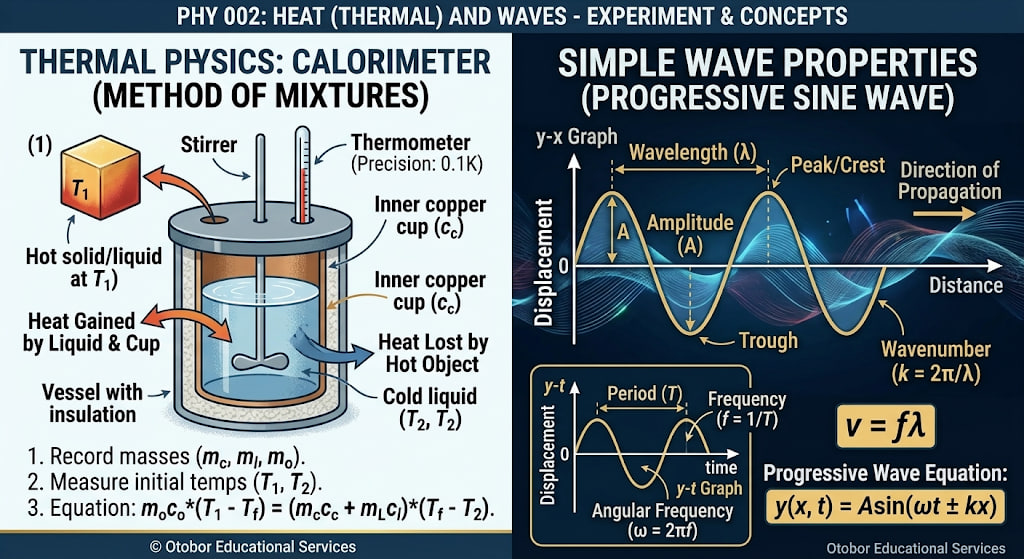

This first-semester course transitions your understanding from solid macroscopic objects to energy transfer and propagation. Mastery here is required before tackling electrostatics in the second semester.
Focus Areas in PHY 002:
- Thermal Physics and Thermodynamics: You will move beyond basic heat capacity to understand the kinetic theory of gases and master the First Law of Thermodynamics ($\Delta Q = \Delta U + \Delta W$), with precise sign conventions for work and internal energy.
- Wave Motion and Acoustics: Understand progressive wave equations ($y = A\sin(\omega t – kx)$), interference, diffraction, and the Doppler Effect for sound. Candidates must derive standing wave conditions in air columns (closed and open pipes).
- Optics: Geometrical Optics (reflection and refraction through parallel plates, triangular prisms, and lenses) is a major topic. You will master physical proofs, the lens maker’s equation, and complex optical instruments like compound microscopes and astronomical telescopes.
Our Otobor Study Pack for PHY 002 includes detailed derivation guides for every single wave and optical phenomenon tested by the board.
PHY 003: Electricity and Magnetism (3 UNITS)
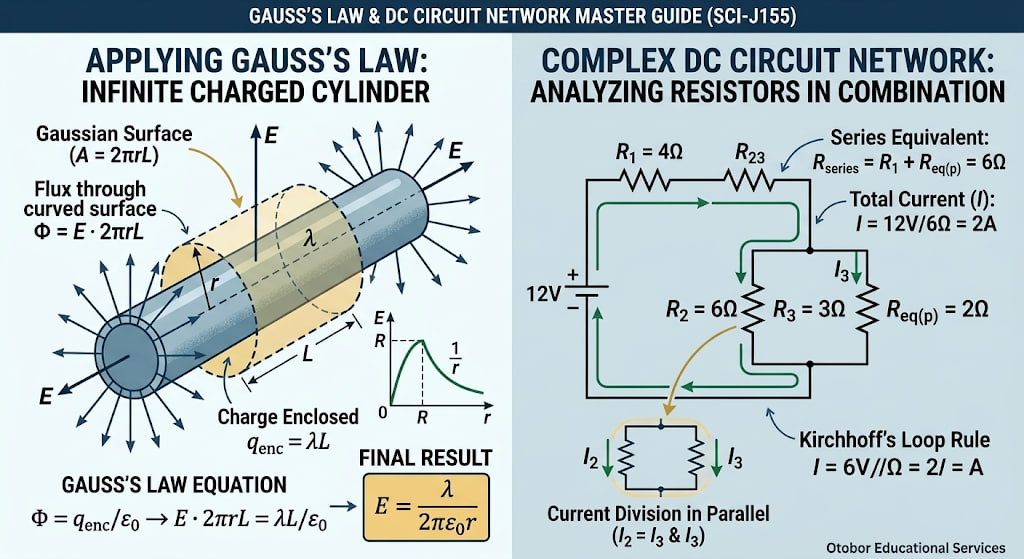
[IMAGE PLACEHOLDER: Insert visual diagram illustrating Gauss's Law applied to a charged cylinder and a simple DC circuit network]
This second-semester course is often cited by candidates as the most challenging module. It introduces abstract fields and complex mathematical modeling. We emphasize structured learning to simplify these topics.
Focus Areas in PHY 003:
- Electrostatics: Master Coulomb’s law, electric field strength, and potential energy. You must master Gauss’s Law ($\oint E \cdot dA = Q_{enclosed}/\varepsilon_0$) and its application to calculating electric fields of symmetrical charge distributions (spheres, cylinders, sheets).
- Capacitance: Parallel plate capacitor formulas ($C = \varepsilon A/d$), dielectrics, and energy stored in a charged capacitor ($U = \frac{1}{2}CV^2$).
- DC Circuits: Master Kirchhoff’s laws (Junction and Loop rules) to solve complex electrical networks. Understand and use potentiometers and Wheatstone bridges for resistance and EMF measurements.
- Electromagnetism and AC Circuits: Study Biot-Savart law and Ampere’s circuital law for magnetic fields. Candidates will analyze RLC series circuits, calculate impedance, resonance frequency ($f_0 = \frac{1}{2\pi\sqrt{LC}}$), and power factors. (Italics: The mathematics requires fluency in vector addition, phase diagrams, and calculus derivatives.)
Takeaway: Electricity and Magnetism problems require both calculus and structured diagramming to solve correctly.
PHY 004: Modern Physics (3 UNITS)
[IMAGE PLACEHOLDER: Insert image explaining the Photoelectric Effect and Bohr Model energy transitions]
The final course explores phenomena that classical mechanics cannot explain, shifting your focus to the micro/quantum level and basic electronics.
Focus Areas in PHY 004:
- Quantum and Atomic Physics: Master Planck’s quantum hypothesis and Einstein’s Photoelectric Equation ($hf = W_0 + K_{max}$). Analyze stopping potential versus frequency graphs. Study the Bohr Model of the hydrogen atom, deriving energy levels and spectral lines. Master radioactive decay laws ($\lambda = 0.693/T_{1/2}$) and binding energy per nucleon calculations.
- Modern Phenomena: Understand De Broglie waves, the Uncertainty Principle, X-ray production, and Bragg’s Law.
- Basic Electronics: Learn semiconductor theory (doping, p-type, n-type), p-n junction diodes (forward and reverse bias), full-wave rectification circuits, and fundamental digital logic gates (truth tables and symbols).
Our digital libraries at the Otobor study center are stocked with visualizations of quantum concepts to aid this module’s mastery.
JUPEB Physics Practical Examination Guide (Paper 3)
The practical component is not just an alternative assessment; it is a full, non-negotiable 3-hour examination that tests your real-world ability to conduct research and record data. It often accounts for up to 30% of your total final Physics score.
[IMAGE PLACEHOLDER: Insert photo of essential laboratory equipment: optical benches, multimeters, and physical balances]
Essential Laboratory Competencies
Candidates are tested on their ability to:
- Setup Experiments: Correct use of physical balances, micrometer screw gauges, vernier calipers, spiral springs, optical benches, prisms, lenses, and complex electrical circuits involving potentiometers, resistance boxes, and multiple multimeters.
- Handle Data: Accurate recording of raw readings directly into properly labeled tables with units in headers (e.g., $l$ (cm)).
- Calculate Precision: Master significant figures and decimal places in all calculations, matching the precision of the instrument used. This is a common error point for Nigerian candidates.
- Graph Data: Plot graphs with appropriate scales (avoiding weird ratios), distinctly marked points ($\odot$ or $+$), and clear lines of best fit.
- Calculate Slope and Intercept: Accurately derive physical constants using large slope triangles (covering at least 50% of the graph).
- List Precautions: State at least TWO valid, realistic practical precautions taken during the experiment to avoid specific errors (e.g., “ensured parallax error was avoided when reading the micrometer screw gauge by looking vertically downwards at the scale”).
We provide intensive, hand-on laboratory coaching at all Otobor training facilities in Nigeria. Internal Link: [Check our complete guide to JUPEB practical and past question analysis here].
Examination Structure and Scoring/Grading System
[IMAGE PLACEHOLDER: Insert infographic showing the breakdown of JUPEB Physics Paper 1, Paper 2, and Paper 3 marks distribution]
The JUPEB Physics exam comprises three standard papers administered over several days:
| Paper | Format | Duration | Weighting | Key Assessment Area |
| Paper 1 | Multiple Choice (MCQs) – 50 Questions | 1 Hour | 30% | Conceptual understanding and rapid calculation speed. |
| Paper 2 | Theory/Essay (Compulsory Section A + Optional Section B) | 2 Hours | 40% | Complex derivations, structural explanations, and detailed problem-solving. |
| Paper 3 | Physical Laboratory Practical | 3 Hours | 30% | Observational skills, precision, graphing, and error analysis. |
Official JUPEB Grading Scale
This standard 5-point scale determines your eventual Direct Entry points:
| Score Range | Letter Grade | Grade Points | Performance Level |
| 70% – 100% | A | 5 Points | Excellent |
| 60% – 69% | B | 4 Points | Very Good |
| 50% – 59% | C | 3 Points | Good |
| 45% – 49% | D | 2 Points | Fair |
| 40% – 44% | E | 1 Point | Pass |
| 0% – 39% | F | 0 Points | Fail |
Takeaway: Candidates who register for three subject combinations (e.g., Physics, Chemistry, Math – PCM) can achieve a maximum total of 16 Points (15 Points + 1 Extra Bonus Point if all subjects are passed without an ‘F’). Achieving this requires exceptional dedication.
Recommended Textbooks and Study Materials
Mastering A-Level concepts demands resources beyond standard O-Level Nigerian texts. While New School Physics is great for revision, you must acquire the relevant advanced-level texts. We encourage students at Otobor to utilize multiple references.
Essential References
- Advanced Level Physics by Nelkon and Parker (Nelkon & Parker) – Absolute mandatory text for classical derivations and problem-solving examples.
- Fundamentals of Physics by Halliday, Resnick, and Walker – Recommended for conceptual mastery of mechanics and electrodynamics.
- University Physics with Modern Physics by Young and Freedman – Ideal for calculus-based explanations and modern/nuclear physics modules.
- Calculations in Advanced Level Physics by Ken Bostock and Sue Chandler – Premier choice for numerical calculation practice.
- New School Physics by M.W. Anyakoha – Use for foundational revision only.
High-Yield Strategies for Scoring an ‘A’ in JUPEB Physics
You can find generalize advice anywhere, but these specific strategies are derived from analyzing years of JUPEB performance data of Nigerian students.
1. The Art of Formula Derivation
You cannot simply memorize complex formulas like the range of a projectile or the resonant frequency of an RLC circuit. Paper 2 markers look for the derivation. Train yourself to derive these from first principles during your study.
2. Calculus-Based Problem Solving is Mandatory
A significant percentage of Paper 2 theory and calculation questions require basic derivatives ($\frac{dv}{dt}$ for acceleration) and integrals ($\int v \, dt$ for displacement). If you are not fluent in basic calculus, you will struggle with advanced A-Level physics problems.
3. Master Unit and Significant Figure Precisions early
This is a standard failure point for Nigerian science students. As emphasized in our breakdown of PHY 001, mastering precision measurements in the lab and calculation is non-negotiable for Paper 3.
4. Topic-by-Topic Past Question Analysis
Do not wait until the exam month to look at past questions. We provide Otobor Topical Past Question Guides. As soon as you finish studying a specific syllabus topic (e.g., Gauss’s Law), solve all related questions from the last five years of JUPEB exams.
5. Diagramming Abstract Systems
Draw diagrams of everything. Draw free-body diagrams in mechanics, ray diagrams in optics, complex circuit schematic in electricity, and energy transition diagrams in Modern Physics. A proper diagram is often 50% of the solution to a complex physics problem.
Takeaway: Your physics preparation is only as effective as your structured revision. Utilize topical analysis and derivation practice.
Otobor Study Centers, Registration, and Academic Training Facilities
Achieving an ‘A’ requires more than just self-study; it requires a conducive environment and access to specialized training resources.
Otobor operates accredited study centers and intensive advanced level coaching programs in Nigeria, designed specifically to help students bridge the gap between secondary school knowledge and 100/200 level university curriculum requirements.
Physical Location & Campus Environment
Our primary academic campus is located in a secure, serene environment in Ilorin, Kwara State, Nigeria, with approved affiliate training centers also operational in major academic hubs across Lagos, Ibadan, and Abuja. The main training facility provides students with:
- Modern Physics Laboratories: Fully equipped physics, chemistry, and biology labs designed for weekly hands-on experiments, essential for Paper 3 mastery.
- Structured Lecture Halls: Large, multimedia-capable classrooms designed for complex theoretical physics derivations and visualizations.
- Past Question Libraries: Physical and digital libraries stocked with structured compilations of past JUPEB Physics questions dating back to the program’s inception.
- Secure Student Accommodation: Monitored student hostels with stable power supply and dedicated study areas, ensuring a focused environment.
Additional Academic Services Offered by Otobor
Beyond standard JUPEB registration and coaching, we provide additional comprehensive educational services:
- IJMB (Interim Joint Matriculation Board) Coaching: Complete academic training for Direct Entry university admission, especially for northern institutions.
- Direct Entry Admission Assistance: Counseling and processing support for 200L transition into top universities like UNILAG, UI, UNILORIN, OAU, UNIBEN, and FUTA.
- Remedial & Cambridge A-Level Programs: World-class preparatory tracks for international or foreign university admissions.
- Intensive Practical Bootcamps: Specialized, 3-week practical training sessions designed for external candidates needing hands-on lab skill development.
Italics: Our centers are structured for immersive academic rigor. Students at Otobor don’t just pass; they dominate their exams.
Frequently Asked Questions (FAQs)

Is JUPEB Physics harder than JAMB UTME Physics?
Yes. JAMB Physics tests basic speed and recall of high school physics over 40 multiple-choice questions. JUPEB Physics tests deep analytical problem solving, multi-step mathematical derivations, theory essays, and hands-on laboratory experiments equivalent to 100-Level university coursework.
Can I study Medicine, Engineering, or Computer Science with JUPEB Physics?
Yes. Physics is a mandatory subject combination for all Engineering, Physical Science, Computer Science, and Medical/Health Science programs across participating Nigerian direct-entry institutions. Achieving a high grade is essential for competitiveness.
Where can I download the complete, official JUPEB Physics Syllabus PDF?
We cannot attach PDFs directly to this online article. However, as an active training center, Otobor maintains the latest syllabus documents. Please utilize our contact details below to request the official syllabus PDF, past question packs, or our specialized study guides. We strongly recommend you use our email for the fastest response and direct document delivery.
What is the minimum score required to pass JUPEB Physics?
The minimum passing grade is an E (1 point, 40-44%), but competitive Direct Entry courses (e.g., Engineering, Medicine, or CS) require a grade of A (5 points) or B (4 points) to ensure successful admission.
Contact and Registration Support
For syllabus downloads, direct entry admission processing, registration into the accredited JUPEB program at any of our training centers across Nigeria, or securing hostel placement, contact the Otobor academic admissions team through any of the channels below.
- Official Email: info@otobor.com (We recommend you email us for the fastest response and direct PDF distribution)
- WhatsApp Support: 08039822082
- Direct Telephone Calls: 07010970336
- Telegram Channel & Direct Message: @DocManny
- Official Website: Visit Otobor Educational Services