
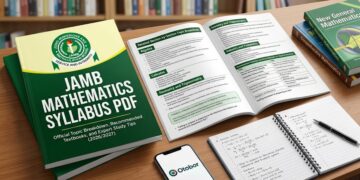



Complete JAMB Physics UTME Syllabus PDF Download & Topic Breakdown
Are you preparing for the upcoming Joint Admissions and Matriculation Board (JAMB) Unified Tertiary Matriculation Examination (UTME)? Achieving a stellar score in Physics requires more than just hard work—it demands strategic preparation aligned directly with the official JAMB syllabus.

“Success in the UTME is not merely about studying hard; it is about studying smart and aligning your preparation directly with the official test parameters.”
1. Introduction to the JAMB Physics Exam

The Unified Tertiary Matriculation Examination (UTME) conducted by JAMB is a gateway examination for candidates seeking admission into Nigerian universities, polytechnics, and colleges of education. Physics is a core subject required for science, engineering, technology, and medical tracks.
To excel in UTME Physics, candidates must understand both the theoretical concepts and mathematical applications of physical laws. Mastering the syllabus ensures that no question takes you by surprise on exam day
2. Why You Need the Official Physics UTME Syllabus

Using the official JAMB Physics syllabus gives you a distinct advantage:
Focused Studying: It prevents you from wasting time on topics outside the scope of the exam.
Understanding Objectives: Each section highlights specific behavioral objectives that questions will test.
Balanced Coverage: It ensures you allocate adequate revision time across all key sections of Physics.
3. Comprehensive JAMB Physics Topic Breakdown
Below is a detailed overview of the core modules and topics contained within the JAMB Physics UTME syllabus.
Section 1: Mechanics
Mechanics forms the backbone of physics. It focuses on motion, forces, energy, and properties of matter.
Measurements and Units: Fundamental and derived quantities, SI units, dimensions, and measurement instruments (vernier calipers, micrometer screw gauge).
Kinematics: Vectors and scalars, position-time and velocity-time graphs, equations of uniform motion, projectile motion.
Dynamics: Newton’s laws of motion, momentum, impulse, conservation of linear momentum, collisions (elastic and inelastic).
Work, Energy, and Power: Work done by constant and variable forces, kinetic and potential energy, conservation of mechanical energy, efficiency of machines.
Circular Motion & Gravitation: Centripetal force and acceleration, Kepler’s laws, Newton’s law of universal gravitation, gravitational field strength, satellite motion.
Equilibrium of Forces: Parallel and non-parallel forces, moments, center of gravity, conditions for equilibrium of rigid bodies.
Simple Harmonic Motion (SHM): Periodic motion, simple pendulum, mass-spring system, energy transfers in SHM.
Fluids & Properties of Matter: Density, relative density, pressure in liquids, Archimedes’ principle, flotation, surface tension, capillarity, viscosity, and elasticity (Hooke’s law, Young’s modulus).
Section 2: Thermal Physics
Thermal physics examines heat transfer, temperature measurements, and thermodynamics.
Thermal Expansion: Expansion of solids, liquids, and gases; real and apparent cubic expansivity; anomalous expansion of water.
Gas Laws: Boyle’s law, Charles’s law, Pressure law, Ideal gas equation ($PV = nRT$).
Heat Capacity & Latent Heat: Specific heat capacity, calorimetry, latent heat of fusion and vaporization, evaporative cooling.
Thermodynamics & Heat Transfer: First law of thermodynamics, conduction, convection, radiation, Stefan-Boltzmann law, blackbody radiation.
Section 3: Waves and Optics
This section covers wave mechanics, sound propagation, and the behavior of light.
| Module | Core Topics Covered | Key Formulas / Concepts |
| Wave Motion | Transverse & longitudinal waves, wave equation, wave reflection, refraction, diffraction, interference. | $v = f \lambda$ |
| Sound Waves | Speed of sound, pitch, loudness, timbre, resonance, Doppler effect, stationary waves in pipes and strings. | Fundamental frequencies, Harmonics |
| Reflection & Refraction of Light | Plane & curved mirrors, Snell’s law, total internal reflection, critical angle, prisms. | $\frac{1}{f} = \frac{1}{u} + \frac{1}{v}$ |
| Lenses & Optical Instruments | Convex & concave lenses, lens maker’s equation, microscopes, telescopes, human eye defects & corrections. | Magnification ($M = \frac{v}{u}$) |

Section 4: Electricity and Magnetism
Electricity and Magnetism test electric charges, circuits, magnetic fields, and electromagnetic induction.
Electrostatics: Electric charges, Coulomb’s law, electric field intensity, electric potential, capacitors and capacitance ($C = \frac{Q}{V}$), arrangements of capacitors.
Current Electricity: Ohm’s law, resistance, resistivity, electromotive force (e.m.f.), internal resistance, Kirchhoff’s laws, Wheatstone bridge, potentiometer.
Magnetism: Magnetic fields, magnetic materials, Earth’s magnetic field, magnetic force on moving charges and current-carrying conductors.
Electromagnetic Induction: Faraday’s law, Lenz’s law, AC generators, transformers, step-up/step-down principles, mutual and self-induction.
Alternating Current (AC) Circuits: RLC series circuits, reactance, impedance ($Z$), resonance in AC circuits, power factor.
Section 5: Atomic and Modern Physics
Modern Physics explores subatomic phenomena, quantum concepts, nuclear reactions, and modern electronic applications.
Conduction through Gases & Vacuum: Cathode rays, discharge tubes, thermionic emission, photoelectric effect, Einstein’s photoelectric equation.
Atomic Structure: Thomson, Rutherford, and Bohr models of the atom; energy levels; atomic spectra.
Wave-Particle Duality: De Broglie wavelength, photon energy ($E = hf$), wave behavior of matter.
Nuclear Physics: Radioactivity ($\alpha, \beta, \gamma$ decay), half-life, nuclear fission, nuclear fusion, binding energy, mass defect.
Introductory Electronics: Semiconductors (p-type, n-type), p-n junction diodes, rectification, transistors, solar cells.
4. Official JAMB Recommended Textbooks for Physics

To prepare effectively, candidates are advised to consult the following standard textbooks recommended by JAMB:
Senior Secondary School Physics by P. N. Okeke et al.
New School Physics for Senior Secondary Schools by M. W. Anyakoha.
Comprehensive Certificate Physics by O. A. Ike.
Principles of Physics by Nelkon and Parker.
“Relying on past questions alone without studying core concepts from recommended textbooks limits your ability to solve new or restructured questions.”