

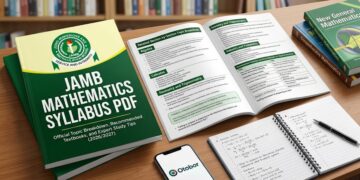



JAMB Mathematics Syllabus PDF (2026/2027): Download Free Guide & Topic Breakdown
Preparing for the Joint Admissions and Matriculation Board (JAMB) Unified Tertiary Matriculation Examination (UTME) in Nigeria requires precision, dedication, and the right resources. For science, social science, and commercial students alike, Mathematics is often a compulsory or pivotal subject that determines eligibility for admission into top Nigerian universities, polytechnics, and colleges of education.
To conquer this hurdle, relying on guesswork is a recipe for failure. You need the official JAMB Mathematics Syllabus PDF to guide your daily revision and ensure you only study what is relevant to the examination. At Otobor, we are committed to providing Nigerian students with accurate academic resources to secure admission into their dream institutions.
“Failing to prepare is preparing to fail. In the context of JAMB Mathematics, studying without the official syllabus is like navigating an unfamiliar city without a map.” — Otobor Academic Team
What is the JAMB Mathematics Syllabus and Why You Need It

The JAMB Mathematics syllabus is an official document released by the examination board to outline the scope, objectives, and specific topics you must cover before sitting for the UTME.
Unlike standard secondary school textbooks that may contain extraneous information or advanced chapters not tested by JAMB, the syllabus acts as a strict boundary. It tells you what to study and how deep the questions will go.
Focus: It helps you prioritize high-yielding topics over minor ones.
Confidence: Knowing the exact requirements eliminates exam anxiety.
Time Management: It allows you to create a realistic study timeline spanning weeks or months.
Detailed Section-by-Section Topic Breakdown
The JAMB Mathematics curriculum is broadly divided into four main sections: Algebra, Calculus, Geometry and Trigonometry, and Statistics and Probability. Below is the comprehensive breakdown of what you need to master.
1. Algebra
Algebra forms the backbone of the UTME mathematics paper. You will encounter questions testing your ability to manipulate expressions, solve equations, and recognize patterns.
Number Bases: Operations in different bases, conversion from one base to another.
Fractions, Decimals, Percentages, and Approximations: Standard forms, significant figures, and decimal places.
Indices, Logarithms, and Surds: Laws of indices, laws of logarithms, simplification of surds.
Polynomials: Factor and remainder theorems, factorization of polynomials.
Variations: Direct, inverse, joint, and partial variations.
Inequalities: Linear and quadratic inequalities in one or two variables.
Progressions: Arithmetic Progression (A.P.) and Geometric Progression (G.P.), including sum to infinity.
Binary Operations: Properties of closure, commutativity, associativity, and distributivity.
Matrices and Determinants: Addition, multiplication, and determinants of 2×22 \times 2 matrices.
2. Calculus
Calculus tests your understanding of continuous change and rates. While it can look intimidating, JAMB questions are typically straightforward and focus on foundational rules.
Differentiation:
Limit of a function
Differentiation from first principles (basic concepts)
Differentiation of algebraic, trigonometric, and logarithmic functions
Product, quotient, and chain rules
Application of differentiation (gradients, maximum and minimum values, rates of change)
Integration:
Integration as the reverse of differentiation
Indefinite and definite integrals
Application of integration to areas under curves
“Calculus is not just a hurdle to cross for your UTME; it is the mathematical language used to describe motion, growth, and change in the physical world.”
3. Geometry and Trigonometry
Spatial reasoning and angular relationships are crucial for scoring high in this segment. Make sure your drawing instruments and formulas are locked down.
Euclidean Geometry:
Properties of angles, lines, triangles, and polygons
Congruent and similar triangles
Circles: angle properties, cyclic quadrilaterals, tangents, and secants
Mensuration:
Lengths of arcs, perimeters, and areas of sectors and segments of circles
Surface areas and volumes of common solids (cylinders, cones, spheres, pyramids)
Trigonometry:
Trigonometric ratios of acute angles
Sine, cosine, and tangent graphs
Sine and cosine rules in triangles
Angles of elevation and depression in three-dimensional problems
Coordinate Geometry:
Midpoint and gradient of a line segment
Equation of a straight line
Distance between two points
Parallel and perpendicular lines
4. Statistics and Probability
Every Nigerian student aiming for professional courses like Engineering, Medicine, or Computer Science must master data interpretation.
Statistics:
Representation of data (histograms, pie charts, bar charts, frequency polygons)
Measures of central tendency (mean, median, mode for grouped and ungrouped data)
Measures of dispersion (range, variance, standard deviation, mean deviation)
Probability:
Experimental and theoretical probability
Addition and multiplication laws of probability
Independent and mutually exclusive events
Recommended Textbooks and Study Materials for Nigerian Students

To effectively cover the topics outlined in the JAMB Mathematics syllabus, you need authoritative textbooks recommended by educational experts in Nigeria. Here are the top titles you should acquire:
New General Mathematics for Senior Secondary Schools by M.F. Macrae et al.
Essential Mathematics for Senior Secondary Schools by A.J.S. Oluwasanmi
Multivariate/Comprehensive Mathematics by Macmillan or Evans publications
JAMB CBT Past Questions and Answers (Compiled editions spanning the last 10 years)
How to Prepare and Pass JAMB Mathematics with High Scores

Scoring 80+ in JAMB Mathematics is entirely achievable if you adopt a disciplined, strategic approach. Follow these proven steps:
Master the Basics First: Do not jump into past questions before understanding fundamental definitions, laws, and theorems.
Practice with CBT Software: JAMB is computer-based. Familiarize yourself with onscreen calculators, time management, and mouse navigation.
Solve Past Questions Regularly: Analyze corrections for every question you miss. Repetition of question styles is common in JAMB.
Create a Timetable: Dedicate at least one hour daily solely to solving mathematical problems.