


JUPEB Mathematics Syllabus PDF
The Joint Universities Preliminary Examinations Board (JUPEB) is an official national examining body approved by the Federal Government of Nigeria. It administers standard A-Level examinations to candidates seeking Direct Entry (DE) admission into 200-level degree programs across participating Nigerian universities.
Mathematics is a foundational pillar within the JUPEB curriculum, serving as a required course for students pursuing degrees in Engineering, Physical Sciences, Actuarial Science, Computer Science, Economics, Accounting, and Business Administration. Navigating the program successfully requires strict alignment with the official examination syllabus. Rather than studying blindly, candidates who utilize the structured syllabus gain precise clarity regarding topic weights, course divisions, and practical exam expectations.
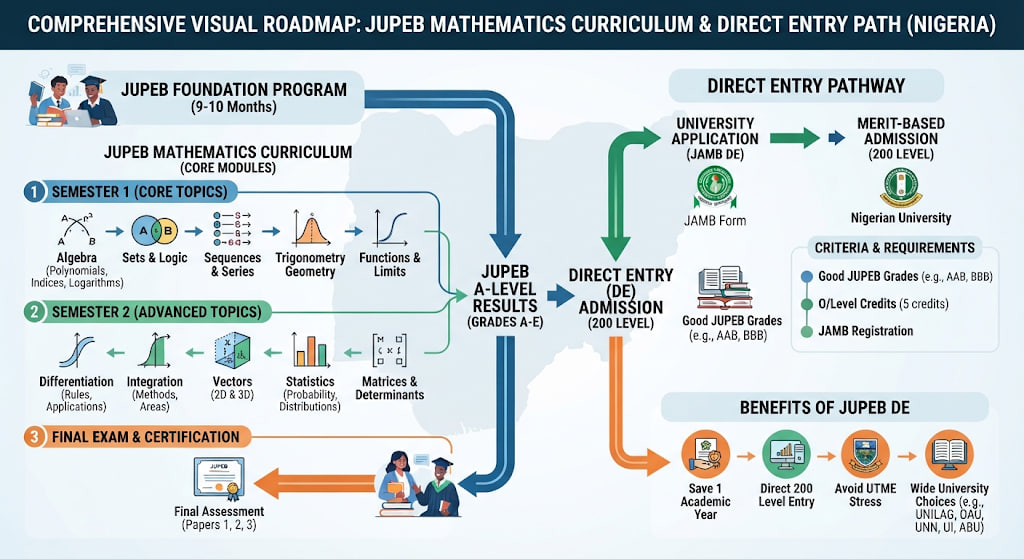
Official General Objectives of the JUPEB Mathematics Curriculum
The official JUPEB Mathematics curriculum is designed to transform secondary school mathematics background into rigorous university-level problem-solving capabilities.
“A precise understanding of mathematical principles serves as the core foundation for logical reasoning and analytical excellence across all scientific, technological, and management disciplines.”
According to the official JUPEB curriculum standards, the general objectives are structured to:
- Help students in developing interest in Mathematics, honing their skills of mathematical thinking in order to stimulate their intellectual curiosity to provide satisfaction in their learning experience.
- Raise students’ consciousness in appreciating Mathematics principles as tools for logical reasoning.
- Sharpen the mathematical skills of students in the applications of Mathematics to real-life situations.
- Develop students to approach and solve a range of mathematical problems creatively and communicate likewise.
- Build a solid mathematical foundation for students in their chosen future endeavors.
Complete Course & Unit Breakdown (MAT 001 – MAT 004)
JUPEB Mathematics is split into two academic semesters consisting of four primary course codes. Each course carries 3 Credit Units. Understanding the distinction between mandatory and elective options in the second semester is essential for proper registration.
| Semester | Course Code | Course Title | Credit Units | Course Status | Target Student Stream |
| First Semester | MAT 001 | Advanced Pure Mathematics | 3 Units | Compulsory | All Mathematics Candidates |
| First Semester | MAT 002 | Calculus | 3 Units | Compulsory | All Mathematics Candidates |
| Second Semester | MAT 003 | Statistics | 3 Units | Compulsory | All Mathematics Candidates |
| Second Semester | MAT 004A | Applied Mathematics | 3 Units | Elective Option A | Physical Sciences, Engineering, Tech |
| Second Semester | MAT 004B | Applied Business Mathematics | 3 Units | Elective Option B | Management Sciences, Finance, Commercial |
Crucial Examination Requirement Note: All candidates registered for JUPEB Mathematics shall be required to answer questions from MAT 001, MAT 002, and MAT 003. MAT 004 is split into two specialized tracks (MAT 004A and MAT 004B), of which each candidate will be required to choose and answer questions from ONLY ONE of either option based on their intended university discipline.
[INSERT IMAGE HERE: Visual chart illustrating mandatory MAT 001-003 modules and the MAT 004A vs MAT 004B elective choice]
Deep-Dive Module Syllabus Analysis
MAT 001: Advanced Pure Mathematics (3 Units)
MAT 001 forms the foundation of pure algebraic reasoning, set theory, and structural mathematical proof during the first semester.
- Set Theory & Logic: Mathematical statements, truth tables, logical equivalence, Venn diagrams, power sets, Cartesian products, and methods of mathematical proof including direct proof, contradiction, and mathematical induction.
- Polynomials & Algebraic Equations: Remainder theorem, factor theorem, roots of cubic and higher-order equations, partial fraction decomposition, and solving simultaneous equations involving linear and non-linear variables.
- Trigonometry: Radian measure, compound angles ($\sin(A \pm B)$, $\cos(A \pm B)$), double angles, half angles, factor formulas, trigonometric identity proofs, and solving trigonometric equations within specific domains.
- Complex Numbers: Definition of complex numbers $z = a + ib$, conjugate, modulus, argument, Argand diagrams, polar coordinates, exponential form ($e^{i\theta}$), and applications of De Moivre’s Theorem to evaluate powers and $n$-th roots.
- Matrices & Determinants: Matrix operations (addition, scalar multiplication, matrix multiplication), determinants of $2 \times 2$ and $3 \times 3$ matrices, transpose, inverse matrix calculation, and applying Cramer’s Rule to solve systems of three linear equations.
MAT 002: Calculus (3 Units)
Calculus constitutes one of the most heavily tested domains in the JUPEB First Semester examination. Mastery of differentiation and integration techniques is non-negotiable for securing an A grade.
- Limits & Continuity: Intuitive concept of limits, left-hand and right-hand limits, evaluating limits using algebraic manipulation and L’Hôpital’s Rule, and defining continuous functions on closed intervals.
- Differential Calculus: First-principles differentiation, standard derivatives, product rule, quotient rule, chain rule for composite functions, implicit differentiation, logarithmic differentiation, and parametric differentiation.
- Applications of Differentiation: Tangents and normals to curves, stationary points (local maxima, local minima, and points of inflection), rate of change problems, rectilinear motion (velocity and acceleration), and curve sketching.
- Integral Calculus: Standard antiderivatives, definite and indefinite integrals, integration by direct substitution, integration by parts, integration using partial fractions, and integration of trigonometric functions.
- Applications of Integration: Calculating areas bounded by plane curves and axes, volumes of solids of revolution about the $x$-axis or $y$-axis, and mean values of functions.
- First & Second Order Differential Equations: Differential equations with separable variables, homogeneous first-order equations, linear first-order differential equations using integrating factors ($IF = e^{\int P dx}$), and solving second-order linear homogeneous differential equations with constant coefficients.
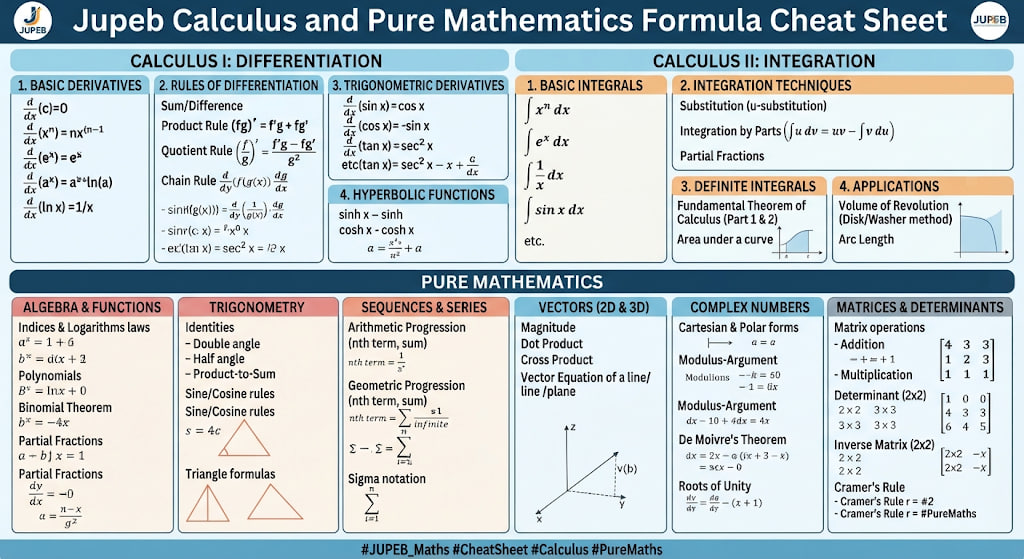
MAT 003: Statistics (3 Units)
MAT 003 provides candidates with essential tools for data representation, probability estimation, and statistical inference.
- Permutations & Combinations: Fundamental counting principles, factorials, arrangements of distinct and non-distinct objects, combinations ($nCr$), and binomial theorem expansion for positive integers.
- Probability Theory: Random experiments, sample spaces, events, probability axioms, conditional probability, independent events, mutually exclusive events, tree diagrams, and Bayes’ Theorem.
- Probability Distributions: Concept of random variables (discrete and continuous), probability mass functions (pmf), probability density functions (pdf), cumulative distribution functions (cdf), expectation $E(X)$, and variance $Var(X)$.
- Standard Theoretical Distributions: Properties, parameters, mean, and variance of the Binomial Distribution $B(n, p)$, Poisson Distribution $P(\lambda)$, and the Standard Normal Distribution $Z \sim N(0, 1)$ including standard score conversions and normal curve tables.
- Inferential Statistics & Hypothesis Testing: Population parameters vs. sample statistics, null hypothesis ($H_0$), alternative hypothesis ($H_1$), Type I ($\alpha$) and Type II ($\beta$) errors, significance levels, critical regions, single-mean $Z$-tests, Student’s $t$-test for small samples ($n < 30$), and Chi-Square ($\chi^2$) tests for independence and goodness of fit.
- Correlation & Regression: Scatter diagrams, Pearson’s product-moment correlation coefficient ($r$), Spearman’s rank correlation coefficient ($\rho$), and determining the least-squares linear regression line equation ($y = a + bx$).
CLICK HERE TO DOWNLOAD SYLLABUS

MAT 004 Track Options: Applied Mathematics vs. Applied Business Mathematics
In the second semester, candidates choose between MAT 004A and MAT 004B based on their intended degree program.
                          ┌────────────────────────────────┐
                          │    JUPEB MAT 004 TRACK CHOICE  │
                          └───────────────┬────────────────┘
                                          │
            ┌─────────────────────────────┴─────────────────────────────┐
            ▼                                                           ▼
┌───────────────────────────────────────┐   ┌───────────────────────────────────────┐
│     MAT 004A: APPLIED MATHEMATICS     │   │ MAT 004B: APPLIED BUSINESS MATH       │
│  • Vector Algebra in 2D & 3D Space    │   │  • Simple & Compound Interest         │
│  • Kinematics & Rectilinear Motion    │   │  • Annuities, Amortization, Sinking   │
│  • Dynamics: Newton's Laws & Energy   │   │  • Linear Programming & Optimization  │
│  • Statics: Forces, Moments, Friction │   │  • Marginal Analysis & Business Model │
│  • Recommended for Physical Sciences  │   │  • Recommended for Management Science │
└───────────────────────────────────────┘   └───────────────────────────────────────┘
MAT 004A: Applied Mathematics (3 Units)
This module is tailored for students entering Engineering, Physics, Geophysics, Industrial Chemistry, Mathematics, and Computer Science.
- Vector Algebra: Vectors in two and three dimensions, position vectors, magnitude, unit vectors ($i, j, k$), direction cosines, scalar (dot) product, vector (cross) product, vector projections, and vector differentiation/integration.
- Kinematics: Displacement, velocity, and acceleration vectors, motion in a straight line with constant and variable acceleration, velocity-time graphs, projectile motion under gravity, and relative velocity.
- Statics: Composition and resolution of forces acting at a point, equilibrium of coplanar forces, Lami’s Theorem, moments of forces, couples, static and kinetic friction, coefficient of friction, centers of gravity for uniform bodies, and simple framework analysis.
- Dynamics: Newton’s laws of motion, momentum, impulse, conservation of linear momentum, work, kinetic energy, potential energy, work-energy theorem, conservation of mechanical energy, power, connected particles (Atwood’s machine, pulleys, inclined planes), and simple harmonic motion (SHM).
MAT 004B: Applied Business Mathematics (3 Units)
This module is designed for candidates aiming for Accounting, Finance, Economics, Business Administration, Actuarial Science, and Marketing.
- Financial Mathematics: Simple interest, compound interest calculations, effective vs. nominal rates, present value, future value, continuous compounding, discounting techniques, annuities (ordinary annuities and annuities due), sinking funds, debt amortization schedules, and capital budgeting evaluations (NPV and IRR).
- Optimization & Decision Models: Formulating business optimization problems, system of linear inequalities, graphical linear programming, feasible regions, corner-point evaluation, simplex algorithm basics, and cost-minimization/profit-maximization models.
- Business Calculus Applications: Total cost, marginal cost, total revenue, marginal revenue, demand functions, supply functions, profit maximization curves, point elasticity of demand, break-even analysis, inventory control, and EOQ (Economic Order Quantity) modeling.
[INSERT IMAGE HERE: Visual breakdown comparison between MAT 004A Newtonian mechanics and MAT 004B financial mathematics models]
Comprehensive Subject Matrix: Science vs. Business Candidates
To avoid choosing the wrong elective track during your JUPEB registration, consult the breakdown table below to match your degree choice with the appropriate MAT 004 module:
| Proposed University Degree Course | First Semester Courses | Second Semester Courses | Recommended MAT 004 Option |
| Mechanical / Electrical / Civil Engineering | MAT 001, MAT 002 | MAT 003, MAT 004A | MAT 004A (Applied Math) |
| Computer Science / Software Engineering | MAT 001, MAT 002 | MAT 003, MAT 004A | MAT 004A (Applied Math) |
| Physics / Geophysics / Industrial Mathematics | MAT 001, MAT 002 | MAT 003, MAT 004A | MAT 004A (Applied Math) |
| Accounting / Banking & Finance | MAT 001, MAT 002 | MAT 003, MAT 004B | MAT 004B (Business Math) |
| Economics / Business Administration | MAT 001, MAT 002 | MAT 003, MAT 004B | MAT 004B (Business Math) |
| Actuarial Science / Insurance | MAT 001, MAT 002 | MAT 003, MAT 004B | MAT 004B (Business Math) |
Strategic Study Roadmap for Scoring an A Grade (5 Points)
Securing an A grade (5 points) in JUPEB Mathematics requires disciplined execution. JUPEB grades carry significant weight toward your total aggregate score when competing for competitive Direct Entry university slots.
- Strict Syllabus Alignment: Use the syllabus as a daily study checklist. Tick off topics sequentially only after solving multiple practice problems under each objective.
- Master Formula Derivations: Unlike basic objective tests, JUPEB theory papers assign heavy marks to formal mathematical proofs and derivations. Practice deriving calculus rules, trigonometric expansion formulas, and mechanical equations from scratch.
- Show Clear Intermediate Steps:JUPEB examiners award partial credit for intermediate logical steps. Write down state equations, standard formulas, and substitution steps clearly before presenting final numerical answers.
- Time Management & Past Question Drills: Regularly practice past JUPEB Mathematics theory and objective papers under strict timed conditions to build speed, accuracy, and confidence.
Consistent, daily practice on ten multi-step calculus, pure math, or statics problems transforms complex abstract theory into intuitive, automatic problem-solving skill.
Complete Educational Support & Admission Guidance from Otobor
Operating from Lagos, Nigeria, Otobor provides high-yield academic resources, textbook delivery, revision packages, and Direct Entry university admission assistance to JUPEB candidates nationwide.
Our mission is to help Nigerian students successfully navigate JUPEB A-Level exams and secure seamless admission into 200-level university programs across accredited institutions.
Services offered by Otobor include:
- Official JUPEB syllabus downloads, course guides, and topic breakdown schedules across all subject combinations.
- Verified JUPEB past questions with detailed step-by-step solutions for Mathematics, Physics, Chemistry, Biology, Economics, and Management courses.
- Physical and digital nationwide delivery of standard JUPEB textbooks including Lamlad, Dandy, and official module handbooks.
- Strategic Direct Entry university admission consulting for candidates targeting top universities in Nigeria.
If you need the complete JUPEB Mathematics Syllabus PDF, verified revision materials, recommended textbooks, or direct-entry admission counseling, get in touch with us:
- Email (Recommended for fast response): info@otobor.com
- WhatsApp: 08039822082
- Phone Call: 07010970336
- Telegram: @DocManny
Key Takeaways
- Core Course Load: JUPEB Mathematics consists of four 3-unit modules across two academic semesters: MAT 001, MAT 002, MAT 003, and MAT 004.
- Compulsory vs. Elective Structure: MAT 001 (Pure Math), MAT 002 (Calculus), and MAT 003 (Statistics) are mandatory for all math candidates. Candidates must select ONLY ONE elective track between MAT 004A (Applied Math) and MAT 004B (Applied Business Math).
- Target Alignment: Science and Engineering students should register for MAT 004A, while Commercial and Management Science students should opt for MAT 004B.
- Examination Success: High scores depend on step-by-step working, understanding formula derivations, and consistent practice with authentic past questions.
- Academic Partner: Otobor provides official syllabus downloads, verified past question solutions, standard textbook deliveries, and expert Direct Entry admission guidance throughout Nigeria.